
Loading table of contents...
Fragrant Rice or Standard White Rice: Which Is Right for Your Market?
Table of contents
When buyers approach us about Vietnamese rice for the first time, one of the most common questions we hear is a simple one: what is actually the difference between fragrant rice and standard white rice, and which one should I be buying?
It is a fair question. Both categories are widely exported from Vietnam, both arrive in similar packaging, and from a distance they can look alike. But they serve different markets, carry different price points, and perform very differently in the kitchen. Buying the wrong type for your customer base is an easy mistake to make and a frustrating one to undo.
This article explains the practical differences between the two categories so you can match the right product to your market.

Rice fields in the Mekong Delta — the heartland of Vietnamese rice production
What standard white rice actually is
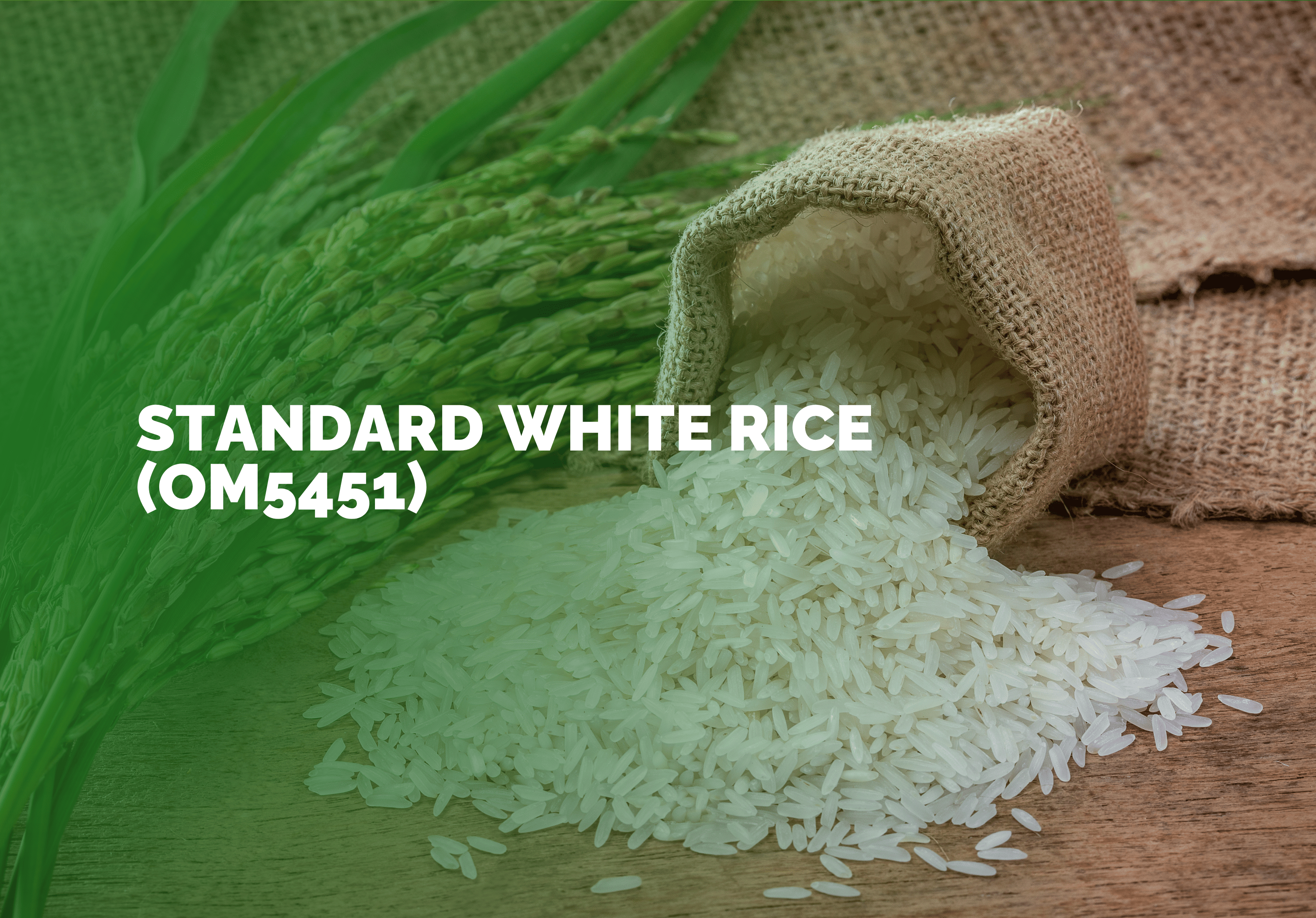 Standard white rice (OM5451) — a trusted long-grain variety for high-volume export markets.
Standard white rice is long-grain rice that has been milled to remove the outer bran layer, leaving a clean, white grain. It has a mild, neutral flavour, a firm texture when cooked, and grains that stay separate rather than clumping together.
In the export trade, standard white rice is primarily a volume product. It is the backbone of large-scale food distribution, government procurement, food aid programmes, and bulk retail in price-sensitive markets. Varieties like OM5451, which Phuoc Hung exports, are well-established and trusted by buyers who need consistent quality at competitive prices across large volumes.
Buyers in West Africa, parts of Southeast Asia, and high-volume food service supply chains are typically looking for exactly this. They want reliability, a clean specification, and predictable pricing. Aroma and texture complexity are secondary considerations.
What fragrant rice is and why it is different
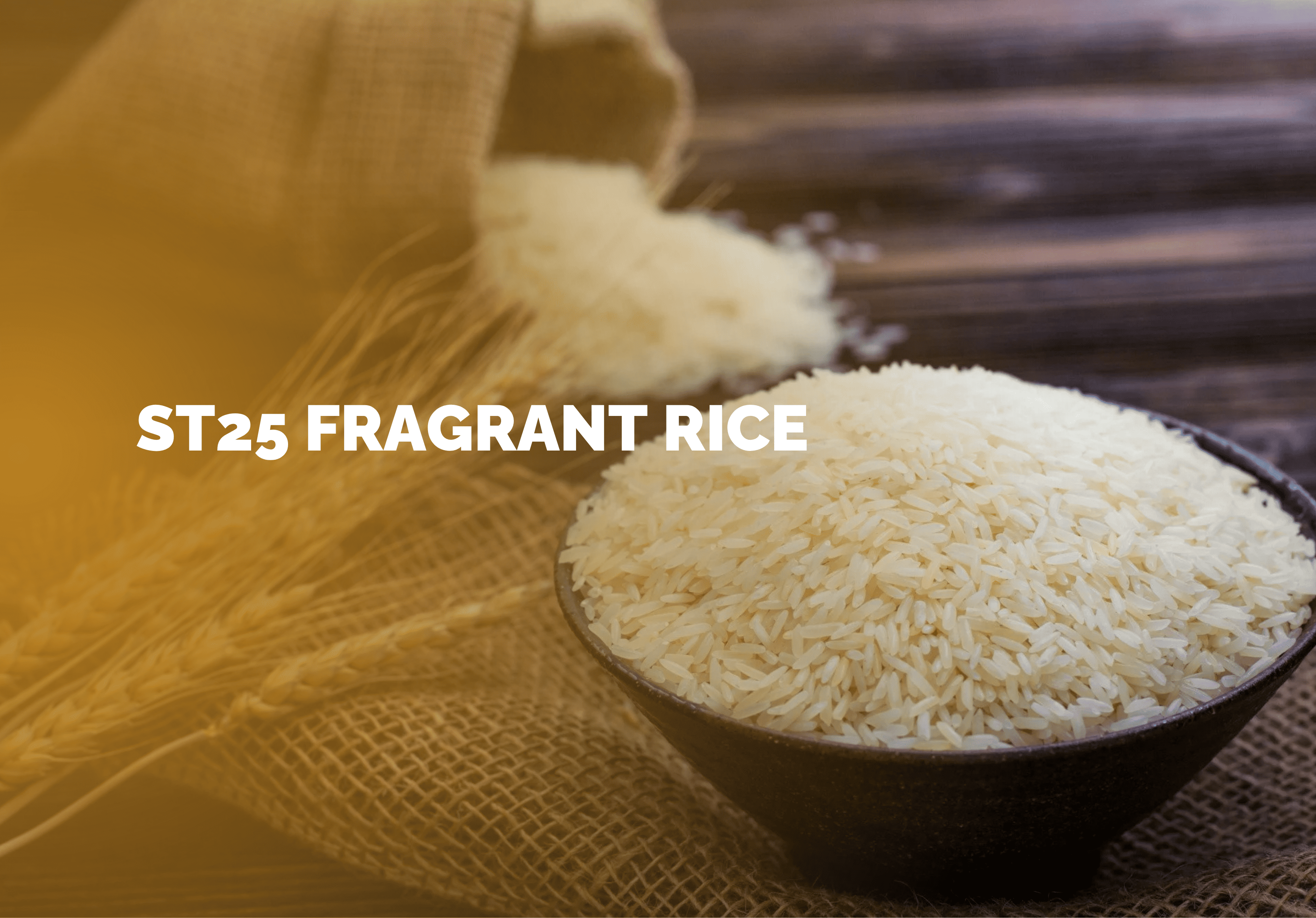
ST25 fragrant rice — Vietnam's most celebrated aromatic variety, awarded World's Best Rice in 2019 and 2023.
Fragrant rice is a category of rice varieties that naturally produce aromatic compounds during cooking. The most recognisable of these is a compound called 2-acetyl-1-pyrroline, which gives the rice a warm, slightly floral scent. It is the same compound found in Thai jasmine rice and Indian basmati, though each variety produces it in a different intensity and character.
Vietnamese fragrant varieties grown in the Mekong Delta include DT8 and ST25. DT8 has a mild, pleasant aroma and sits in the mid-range of the fragrant category in terms of both intensity and price. ST25 has a more distinctive pandan-like fragrance and a notably softer, slightly sticky texture despite being long-grain. It won the World's Best Rice award in 2019 and again in 2023, and commands a significant price premium as a result.
Fragrant rice is not simply better than standard white rice. It is different. The aroma means it suits markets where consumers cook rice as a feature of the meal rather than as a neutral base. It performs especially well in retail settings where the end consumer is choosing the rice themselves and can taste the difference.
|
The European rice market has been shifting noticeably toward fragrant and specialty varieties. Jasmine rice from Southeast Asia, including Vietnamese fragrant varieties, has been growing at around 4% per year in Western European markets as consumers move away from plain long-grain white rice toward more characterful varieties. |
A practical comparison
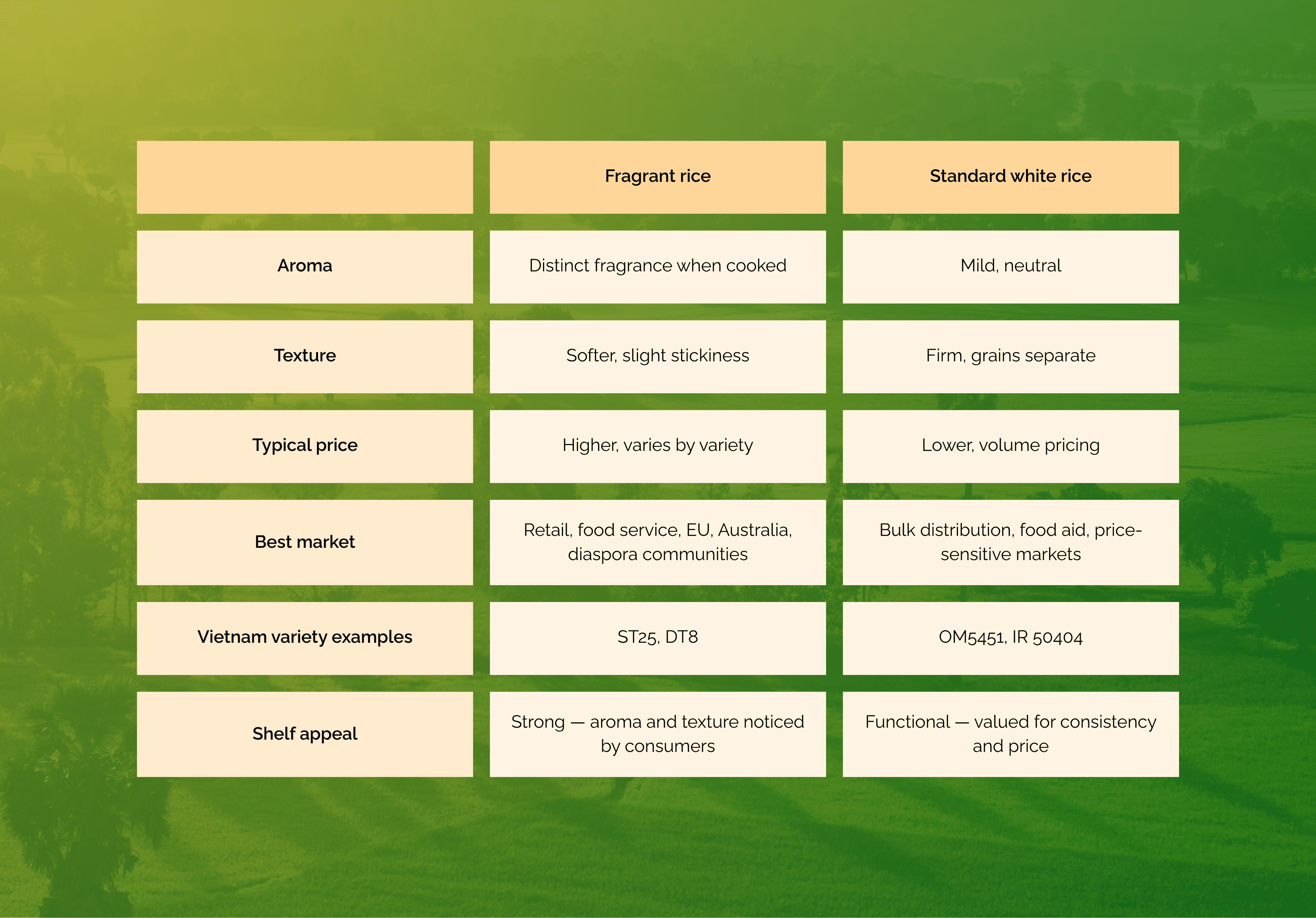
Fragrant rice vs standard white rice — two distinct products for two distinct markets
|
|
Fragrant rice |
Standard white rice |
|
Aroma |
Distinct fragrance when cooked |
Mild, neutral |
|
Texture |
Softer, slight stickiness |
Firm, grains separate |
|
Typical price |
Higher, varies by variety |
Lower, volume pricing |
|
Best market |
Retail, food service, EU, Australia, diaspora communities |
Bulk distribution, food aid, price-sensitive markets |
|
Vietnam variety examples |
ST25, DT8 |
OM5451, IR 50404 |
|
Shelf appeal |
Strong — aroma and texture noticed by consumers |
Functional — valued for consistency and price |
Which category suits your buyers?
The honest answer depends entirely on who is making the purchasing decision at the end of your supply chain.
If your customer is a procurement manager for a government food programme, a large food service operator, or a bulk distributor in a price-sensitive market, standard white rice is almost certainly the right product. Volume, consistency, and price efficiency matter most. Quality is defined by specification compliance rather than sensory experience.
If your customer is a consumer choosing rice from a retail shelf, a restaurant sourcing rice as a deliberate ingredient, or a food distributor serving communities where rice is central to the cuisine, fragrant rice will perform meaningfully better. Consumers in these markets notice aroma and texture, and they come back for them.
Many buyers we work with carry both. Standard white rice handles their volume business and provides pricing flexibility. A fragrant variety sits alongside it as a premium line that generates better margins and stronger repeat purchases. Starting with one and adding the other as your market understanding develops is a practical approach.
A note on getting the specification right
Whichever category you choose, the specification matters as much as the variety. Moisture content, broken grain percentage, milling degree, and grade all affect what the rice looks and tastes like when it reaches the consumer. Fragrant rice in particular is more sensitive to moisture and handling than standard white rice because the aromatic compounds are partly volatile. Rice that arrives too dry, or that has been stored poorly during transit, will have lost some of its fragrance before the consumer ever opens the bag.
If you are sourcing fragrant rice for the first time, requesting a sample and cooking it before committing to a full container is time well spent. The difference between a well-processed fragrant variety and a poorly handled one is noticeable in the kitchen, and it will be noticed by your customers too.
|
Sourcing rice from Vietnam? Phuoc Hung Co., Ltd is a rice processor and exporter based in Can Tho, Vietnam. We supply fragrant and standard white rice varieties to buyers in the Philippines, China, Africa, Europe, and Australia. phuochungrice@gmail.com | +84 369 970 541 |
Post related
ST25 Rice: Why It Commands a Premium and What Importers Should Know
When buyers ask us about ST25 rice, the question is almost always the same: is the price difference actually worth it? The honest answer is yes, but only in the right market. ST25 is not the correct product for every buyer. Understanding what makes it special, who it is designed for, and what to verify before placing an order will help you make that call clearly.
Why the Same Rice Grade Can Perform Differently from Different Suppliers
You have been importing OM5451 for years. You know what it looks like, how it cooks, and what your customers expect. Then you switch to a new supplier, the grade on the contract is identical, the certificate of analysis is within spec, and yet something is noticeably different when the rice reaches your customers. It is not your imagination. The same grade designation can cover a wide range of actual product outcomes depending on where the paddy was sourced, how it was dried, how it was milled, and how carefully it was sorted. This article explains exactly what creates that variation and what to ask a supplier to understand where they sit on that spectrum.
How to Choose a Vietnamese Rice Exporter: A Buyer's Guide
Vietnam is one of the world's largest rice exporters, and the Mekong Delta alone is home to hundreds of processors, millers, and trading companies. For a buyer approaching the market for the first time, or reconsidering an existing supplier relationship, the choice can feel overwhelming. This guide is written from the perspective of a processor based in Can Tho. We have an obvious interest in your business. But the questions below are ones we believe every buyer should ask every potential supplier, including us. A supplier that cannot answer them clearly is telling you something important.