
Loading table of contents...
Why the Same Rice Grade Can Perform Differently from Different Suppliers
Table of contents
Why rice quality varies between suppliers — Phuoc Hung quality control
You have been importing OM5451 for years. You know what it looks like, how it cooks, and what your customers expect. Then you switch to a new supplier, the grade on the contract is identical, the certificate of analysis is within spec, and yet something is noticeably different when the rice reaches your customers.
It is not your imagination. The same grade designation can cover a wide range of actual product outcomes depending on where the paddy was sourced, how it was dried, how it was milled, and how carefully it was sorted. This article explains exactly what creates that variation and what to ask a supplier to understand where they sit on that spectrum.
Grade is a minimum standard, not a description
When a contract specifies OM5451 at 5% broken, 14% moisture maximum, and well-milled, it is setting a floor. Every parameter is a threshold the rice must not fall below or exceed. What the contract does not specify is how far above that floor the rice sits, or how consistently it sits there across every bag in the shipment.
Two shipments can both test at 13.8% moisture and 4.8% broken and still perform quite differently in your market. The difference lies in things the COA does not measure directly: the uniformity of grain size, the degree of milling, the chalky grain content, the condition of the paddy before it entered the mill, and whether the broken grain count is made up of large halves or fine chips.
Understanding what drives those differences is what separates a buyer who manages quality proactively from one who discovers problems after the cargo is already in distribution.
It starts with the paddy
Rice quality is established long before milling begins. The variety, the growing conditions, the harvest timing, and the condition of the paddy when it arrives at the mill all set a ceiling on the quality of what can come out the other end. No mill, however well-equipped, can produce consistently excellent rice from inconsistent paddy.
Processors who buy paddy from a fixed network of farming cooperatives across a consistent set of provinces have a meaningful advantage here. They know their sources. They know which growing areas produce paddy with better grain fill and lower chalky content in a given season. They can make sourcing decisions that protect quality before processing even begins.
Processors who buy on the open market, taking whatever paddy is available at the best price on a given week, have less control over this starting point. The paddy may be consistent or it may not be, and that variability flows through every subsequent step.
|
A supplier with a diversified but fixed paddy sourcing network across multiple Mekong Delta provinces is making a structural investment in quality consistency. One that buys on the spot market is optimising for price. Both can produce compliant rice. Only one reliably produces consistent rice. |
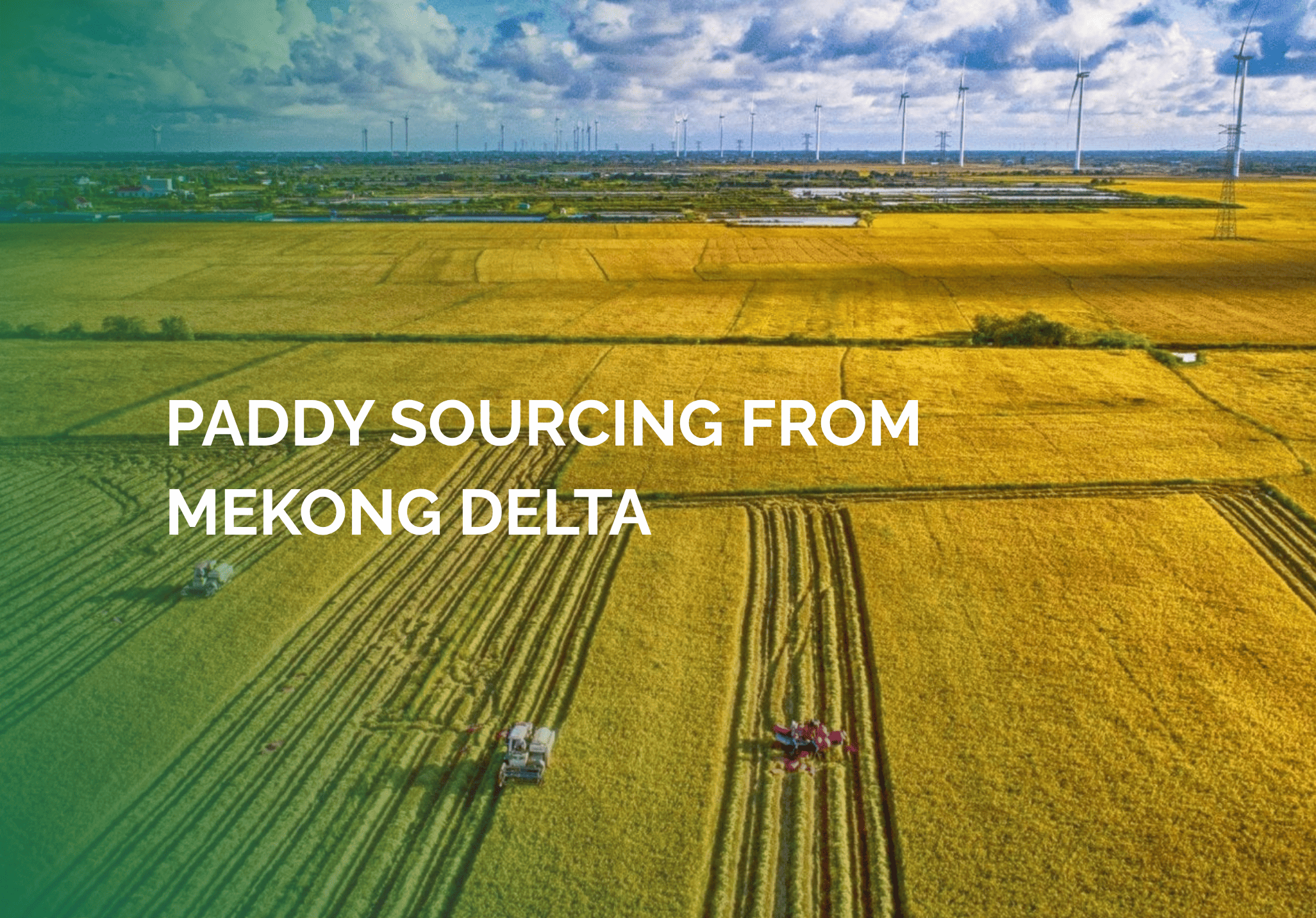
Paddy sourcing from Mekong Delta farming cooperatives — consistent quality starts here
Drying is where most variation is introduced
This is the step that most buyers know the least about, and it is where the greatest quality differences between suppliers originate.
After harvest, fresh paddy contains moisture levels anywhere from 20% to 28%. It must be brought down to 14% or below before milling. How that drying happens determines a great deal about the final quality of the rice.
Vertical tower drying uses controlled airflow and temperature to bring moisture down gradually and evenly. The paddy moves slowly through the tower over several hours, drying at a rate that preserves the structural integrity of the grain. Grains dried this way are less likely to crack during milling because they have not been stressed by rapid temperature change.
Flat bed and rotary drying are faster and cheaper but less precise. They can introduce uneven drying across the batch, producing some grains that are too dry and brittle alongside others that are still slightly moist. When over-dried grains pass through the milling drums, they break. When under-dried grains are packed into bags, they create a moisture inconsistency that affects shelf life.
 Vertical tower drying — controlled moisture reduction for consistent rice quality
Milling degree and colour sorting
Milling is the process that removes the bran layer from the dried paddy to produce white rice. The degree of milling determines how much of the bran is removed. Under-milling leaves a faint brown or beige tinge on the grain and produces a slightly different cooking texture. Over-milling removes too much of the grain itself, increasing breakage and reducing the weight of finished rice per ton of paddy processed.
A mill that controls milling pressure carefully and runs consistent pass counts produces rice with uniform whiteness and lower breakage. A mill that adjusts settings informally or shares equipment between different clients and grades introduces variability that shows up in the COA and on your shelf.
Colour sorting is the final processing step. A properly calibrated industrial colour sorter can remove discoloured grains, broken fragments, and immature chalky grains with high precision. The calibration of that machine and the skill of the operator matter. Rice that has been through a well-run colour sorter at a consistent setting looks and cooks differently from rice that has been through an older machine running at lower throughput with frequent recalibration.
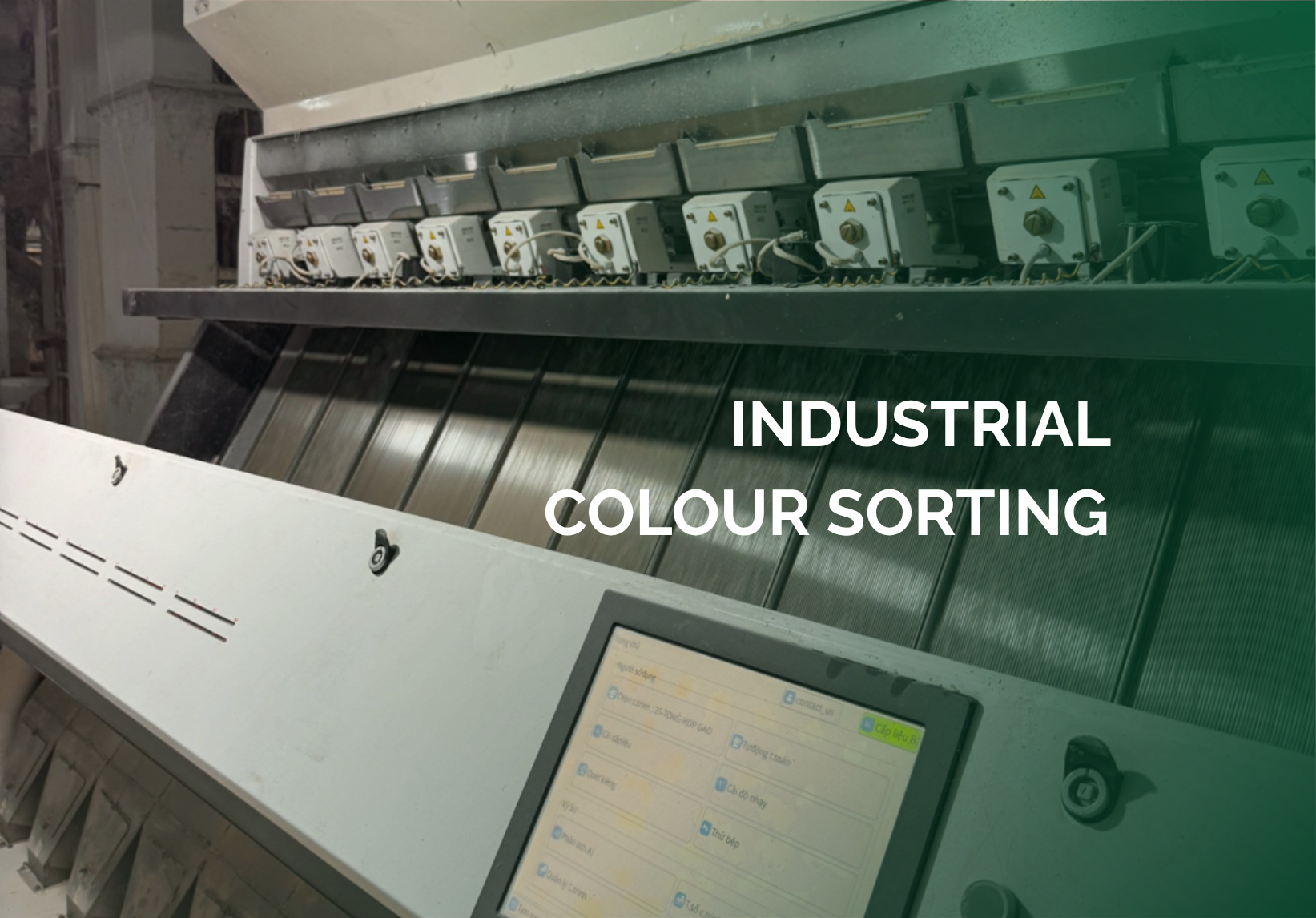
Industrial colour sorting — removing imperfect grains for export-grade white rice
What to ask a potential supplier
The right questions to ask a supplier are not about the grade. They are about the process behind the grade.
- Do you own and operate your own drying facility, milling line, and colour sorter, or do you contract any of these steps to a third party?
- What type of dryer do you use and what is your drying capacity per day?
- Where does your paddy come from? Do you source from fixed farming networks or on the open market?
- Can you provide test results from intermediate processing stages, not just the final COA at loading?
- What is your average moisture result across the last ten shipments to the Philippines, and do you have those COAs available to share?
A supplier who can answer all of those questions directly and specifically is one who understands their own process. A supplier who deflects to the grade specification is telling you something about how much visibility they actually have into what happens between the paddy field and the container.
|
Factor |
Processor with integrated facility |
Trader or small mill |
|
Paddy source |
Large network across multiple known provinces. |
Buys on the open market. Source varies with price. |
|
Drying method |
Vertical tower drying. Controlled temperature. Preserves grain integrity. |
Flat bed or rotary drying. Less precise. Higher breakage and uneven moisture. |
|
Milling |
Owns and operates the mill. Controls milling pressure and pass count. |
Sends paddy to a contracted mill. Limited visibility into the milling process. |
|
Colour sorting |
Industrial colour sorter running at consistent calibration across large batches. |
May share a colour sorter with other clients. Calibration varies by operator. |
|
Quality testing |
In-house testing at each stage plus third-party COA before loading. |
COA issued at loading only. No visibility into intermediate process steps. |
|
Batch tracing |
Full traceability from paddy intake to packed bag by lot number. |
Limited or no traceability once rice changes hands between processor and trader. |
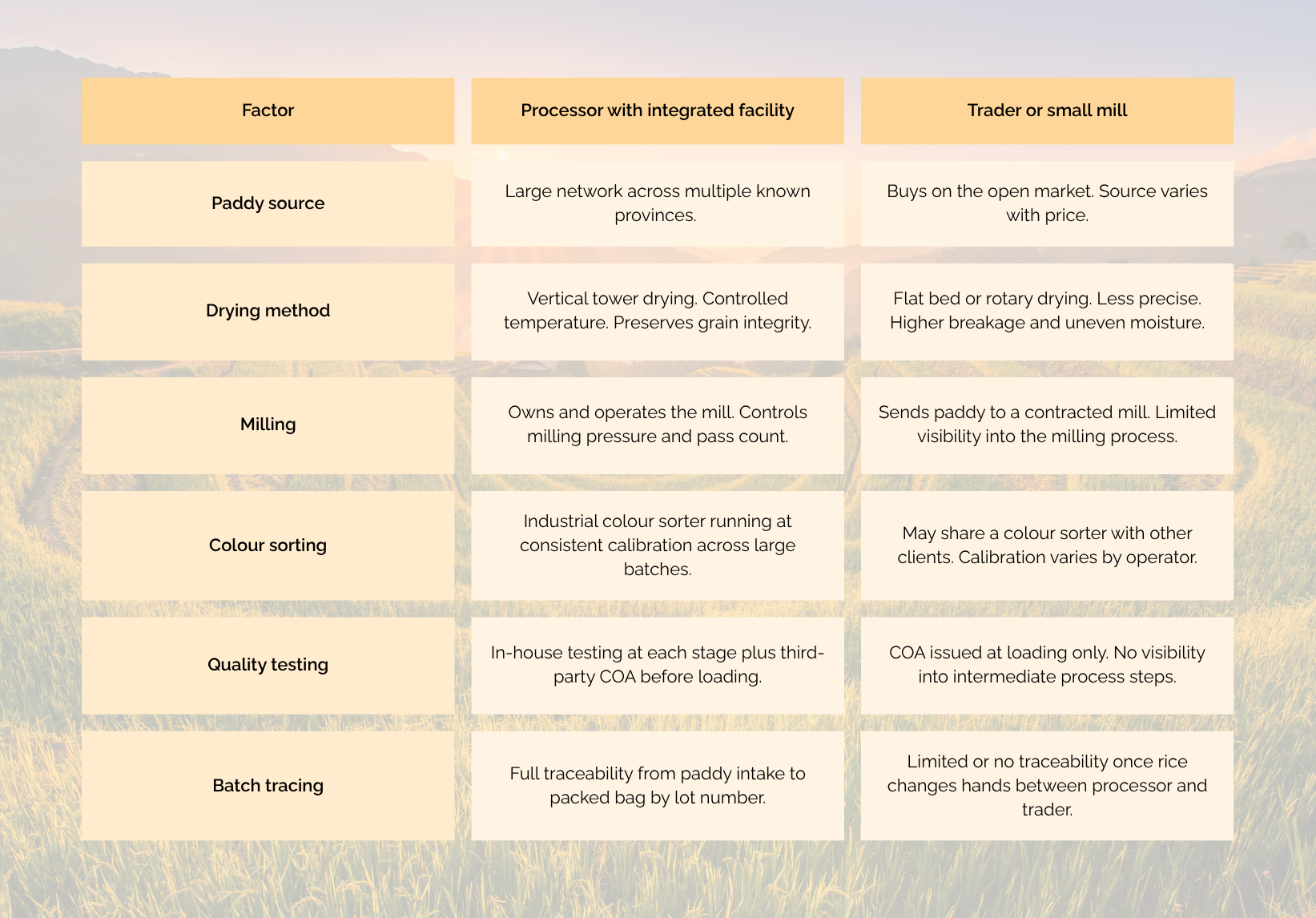
Key questions to ask a Vietnamese rice supplier before placing an order
Working with a Vietnamese rice supplier?Phuoc Hung Co., Ltd processes and exports OM5451 and other Mekong Delta rice grades directly from our integrated facility in Can Tho. We own our drying towers, our mill, and our colour sorting line. We source paddy from the same farming networks across six provinces season after season. phuochungrice@gmail.com | +84 369 970 541 |
Post related
ST25 Rice: Why It Commands a Premium and What Importers Should Know
When buyers ask us about ST25 rice, the question is almost always the same: is the price difference actually worth it? The honest answer is yes, but only in the right market. ST25 is not the correct product for every buyer. Understanding what makes it special, who it is designed for, and what to verify before placing an order will help you make that call clearly.

How to Choose a Vietnamese Rice Exporter: A Buyer's Guide
Vietnam is one of the world's largest rice exporters, and the Mekong Delta alone is home to hundreds of processors, millers, and trading companies. For a buyer approaching the market for the first time, or reconsidering an existing supplier relationship, the choice can feel overwhelming. This guide is written from the perspective of a processor based in Can Tho. We have an obvious interest in your business. But the questions below are ones we believe every buyer should ask every potential supplier, including us. A supplier that cannot answer them clearly is telling you something important.
Fragrant Rice or Standard White Rice: Which Is Right for Your Market?
When buyers approach us about Vietnamese rice for the first time, one of the most common questions we hear is a simple one: what is actually the difference between fragrant rice and standard white rice, and which one should I be buying? It is a fair question. Both categories are widely exported from Vietnam, both arrive in similar packaging, and from a distance they can look alike. But they serve different markets, carry different price points, and perform very differently in the kitchen. Buying the wrong type for your customer base is an easy mistake to make and a frustrating one to undo. This article explains the practical differences between the two categories so you can match the right product to your market.